
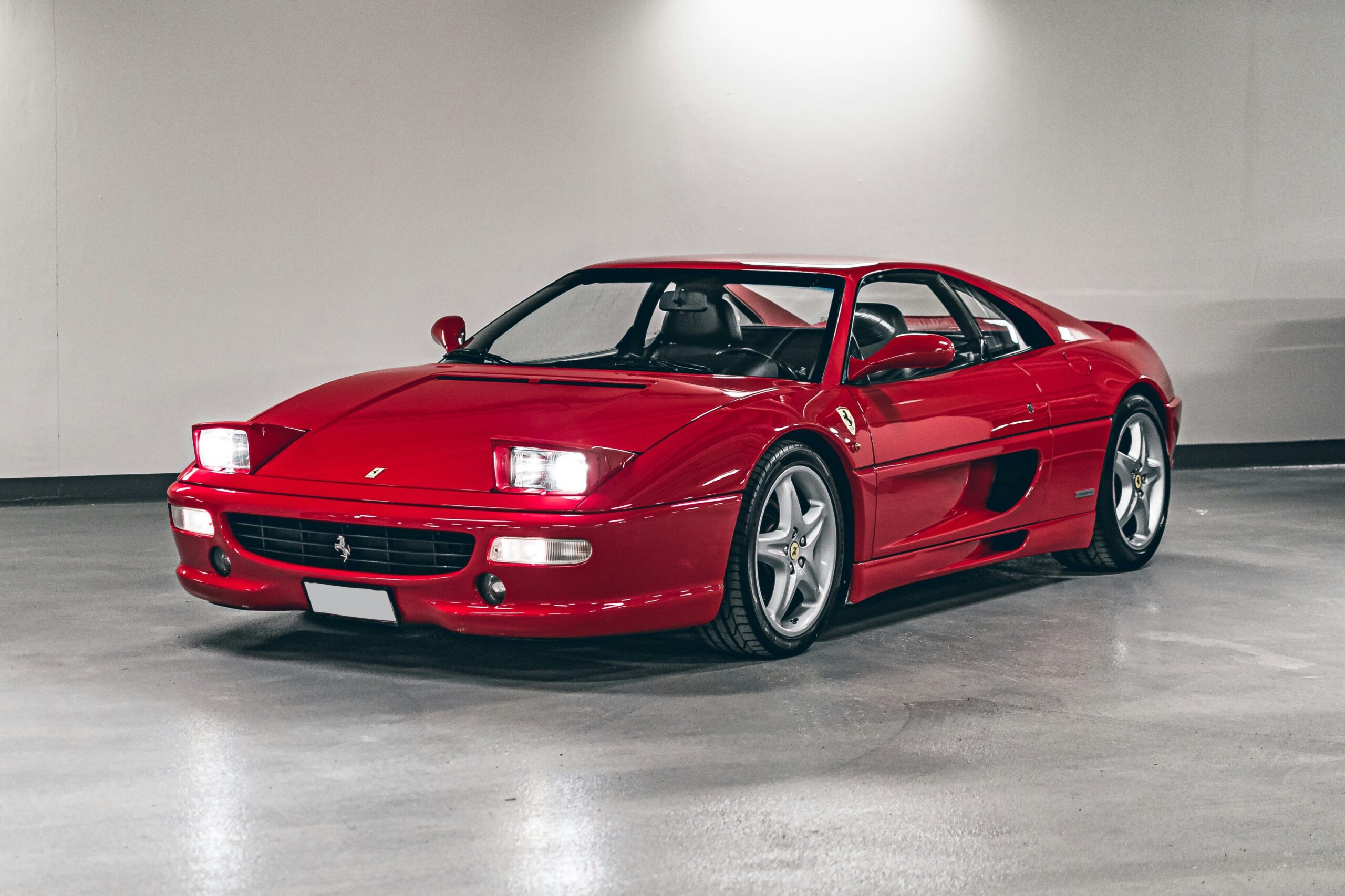
The Ferrari F355 is the car that ended an era and started an obsession. The 348 had been fairly slow, awkward, and outclassed by Honda’s NSX. The F355 did something few other Ferraris managed: it became the car that almost everyone, regardless of age, budget, or taste, agrees is one of the most beautiful production Ferraris ever made.
That consensus has not yet fully translated into price. The Ferrari F355 investment question sits in a peculiar spot in the collector market — too recent and too numerous to be treated like a Testarossa or the 328, too complex and expensive to maintain to be loved unconditionally the way the 458 is.
The result is a fear premium that has kept values artificially suppressed for years and is only now starting to dissolve. For the buyer who understands what they are looking at and what to avoid, the window on genuinely undervalued F355s is still open.
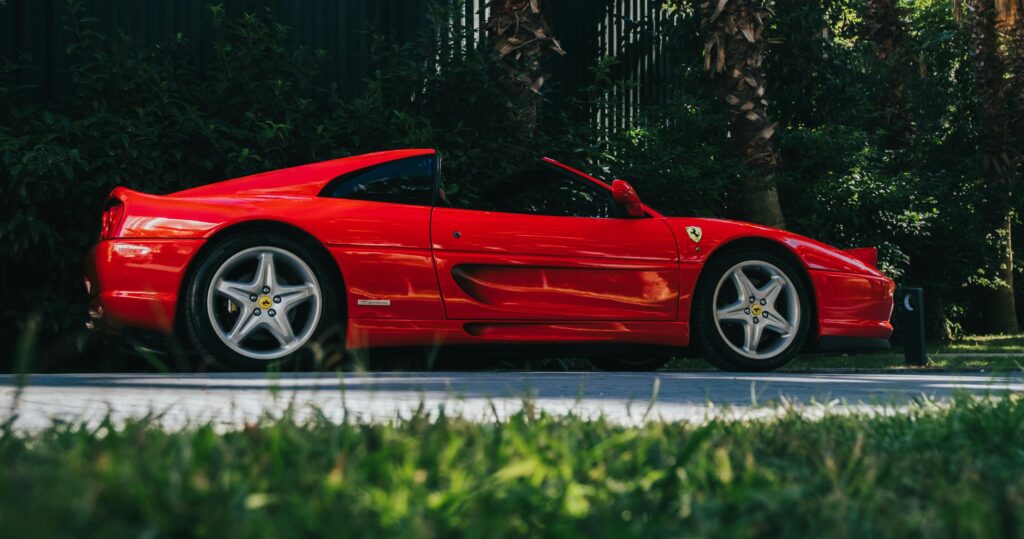
Table of Contents
Meet the Ferrari F355
The story of the Ferrari F355 begins with a failure. By the early 1990s, Ferrari’s 348 had become somewhat of an embarrassment. The car had been neutered by emissions regulations, criticised for its wayward handling, and made to look half-hearted by the Honda NSX — a Japanese sports car that arrived in 1990 and immediately redefined what a mid-engined supercar could be in daily use.
Ferrari’s then-president Luca di Montezemolo understood the gravity of the situation. The answer arrived at the Geneva Motor Show in March 1994 as the F355. It was a thorough evolution of the 348 — not a clean-sheet redesign — but it was so comprehensively improved in every area that it felt entirely different. Some of the body panels between a 348 and a 355 are interchangeable, but no Ferrari fan has ever confused the two. That alone tells you something about what Pininfarina achieved.
The engine was the headline. Ferrari’s engineers developed a new 3.5-litre flat-plane crank V8 with five valves per cylinder — which is where the name comes from: 3.5 litres, 5 valves. With titanium connecting rods and revised engine management, the unit produced 375bhp and was capable of revving to 8,500rpm. At launch, it had one of the highest specific outputs of any naturally aspirated road car engine in production — 109bhp per litre.
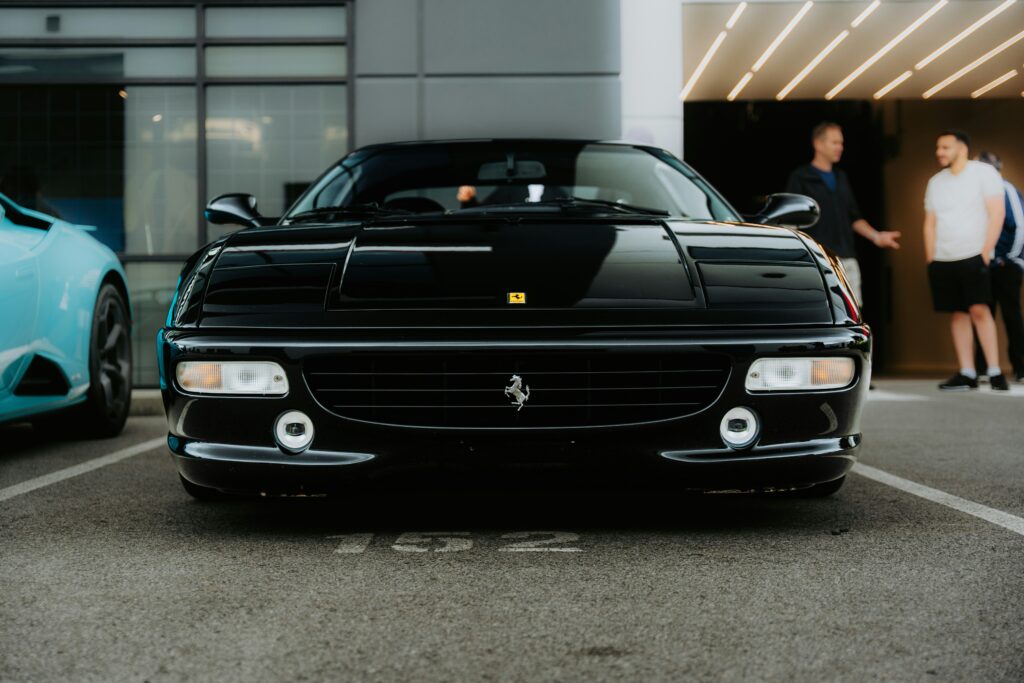
That number sounds academic. The experience of using it is not. Below 5,500rpm the F355’s engine is busy and unremarkable. Above it, everything changes. The note homogenises into a sound that automotive writers have been struggling to describe for thirty years and never quite managing. It is the reason people who have driven hundreds of cars still talk about the F355 the way they do.
The rest of the car matched the engine. The chassis was redesigned with double wishbone suspension, electronically adjustable two-stage dampers, and a flat aerodynamic undertray that was a genuine first for a Ferrari road car. The gearbox gained a heat exchanger to warm the oil quickly from cold starts, solving the notoriously stiff shifts of the 348. The gear linkage was changed from cables to rods. The result was a gearchange — through that open aluminium gate — that ranked among the best of any manual car made in the 1990s.
By the time production ended in 1999 — with Berlinetta and GTS models replaced by the 360 Modena, the Spider following in early 2000 — Ferrari had built around 11,000 F355s of all types. That volume has always worked against its collectability. It is now starting to work in its favour.
The Full F355 Variant Lineup
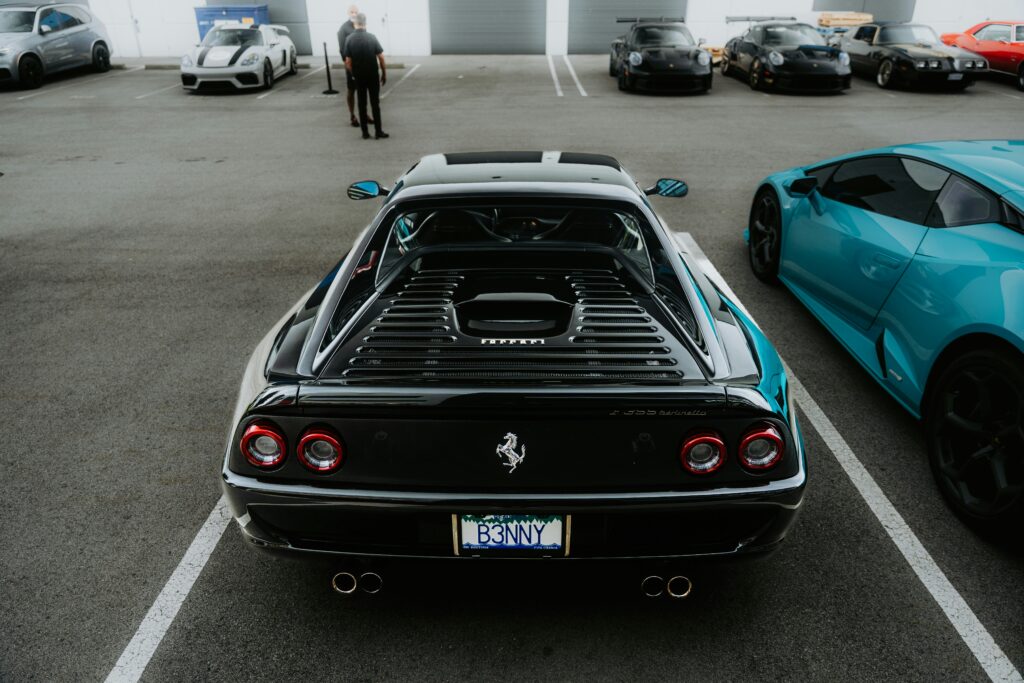
Body styles:
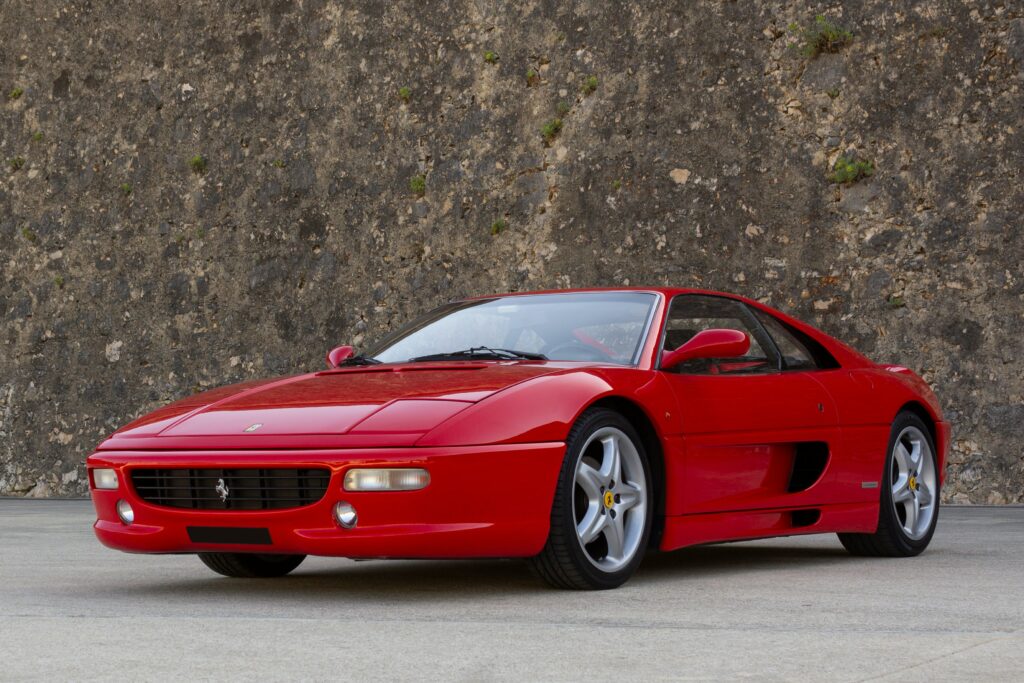
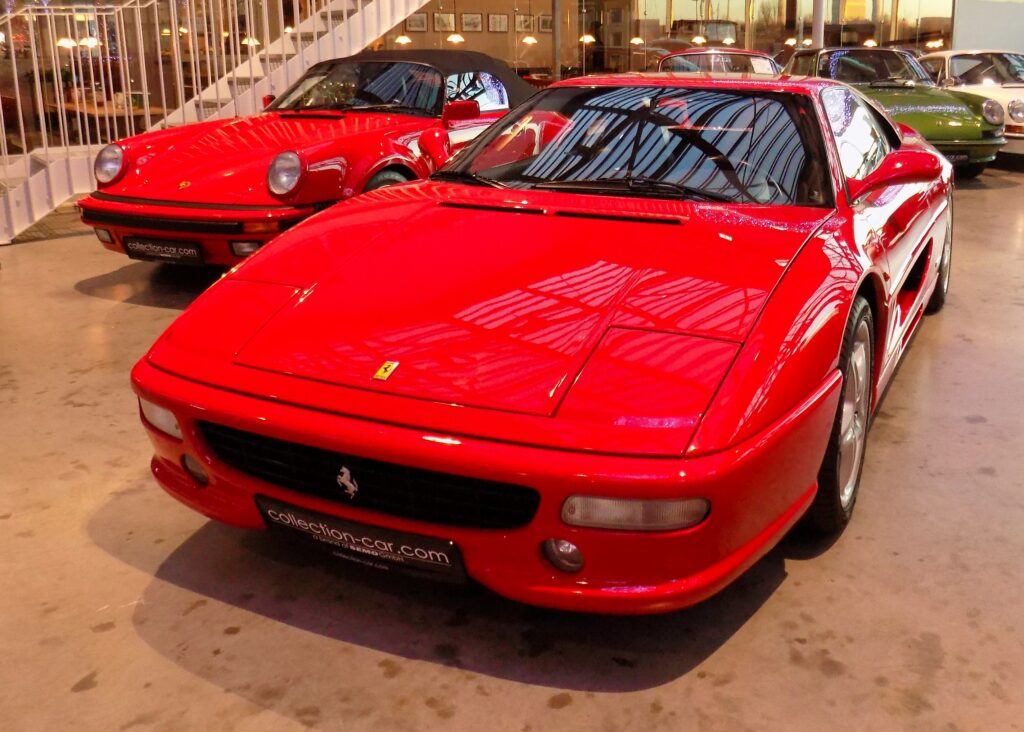
- Berlinetta (GTB) — Fixed-head coupe. First body style available, launched at Geneva 1994. 4,871 produced. The purist choice and, for most serious buyers, the definitive F355.
- GTS — Targa roof. Removable roof panel sits behind the seats. Glass rear window. 2,577 produced, making it the rarest body style. Last mid-engine V8 Ferrari to offer a targa option — the 360 did not carry it forward.
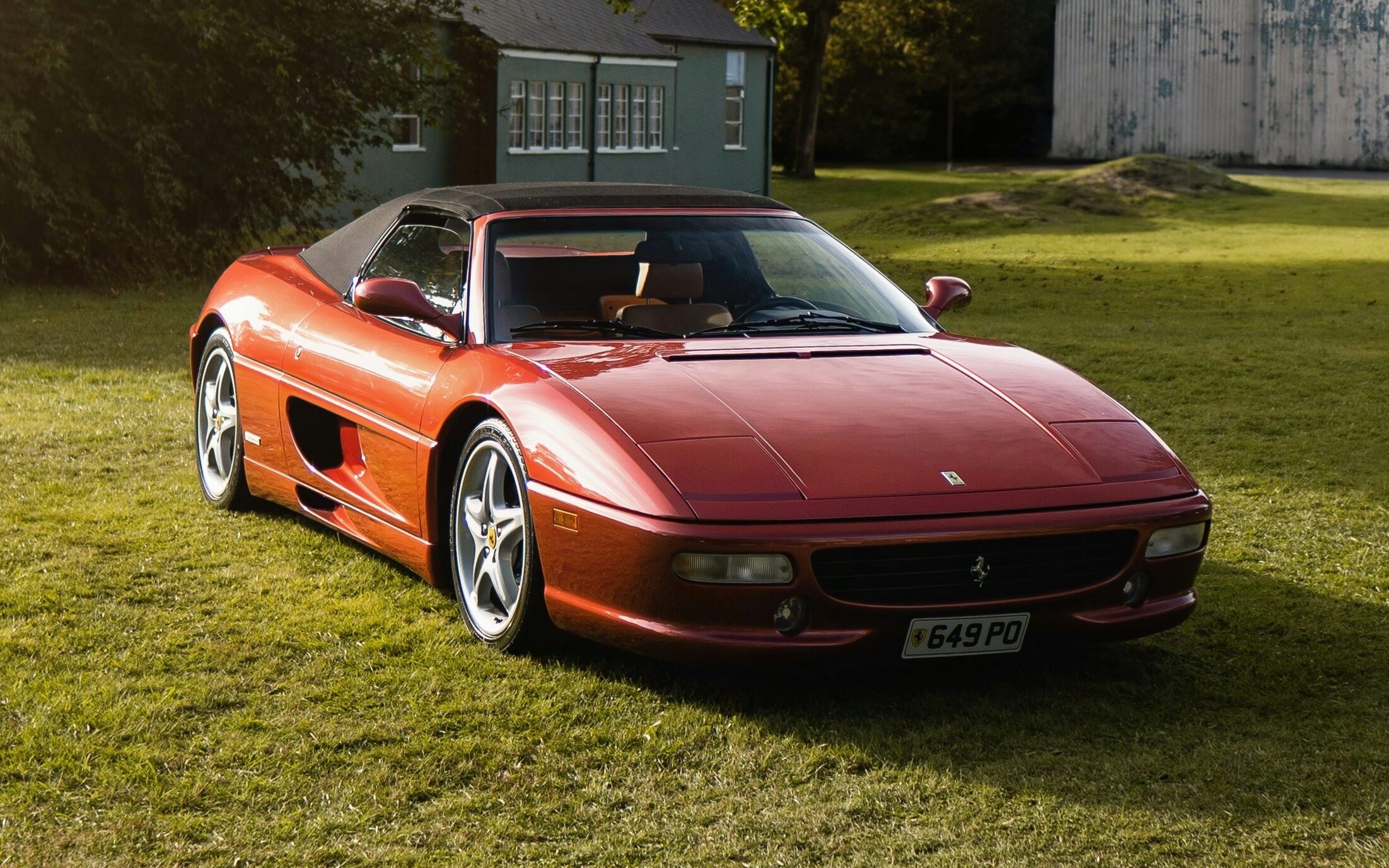
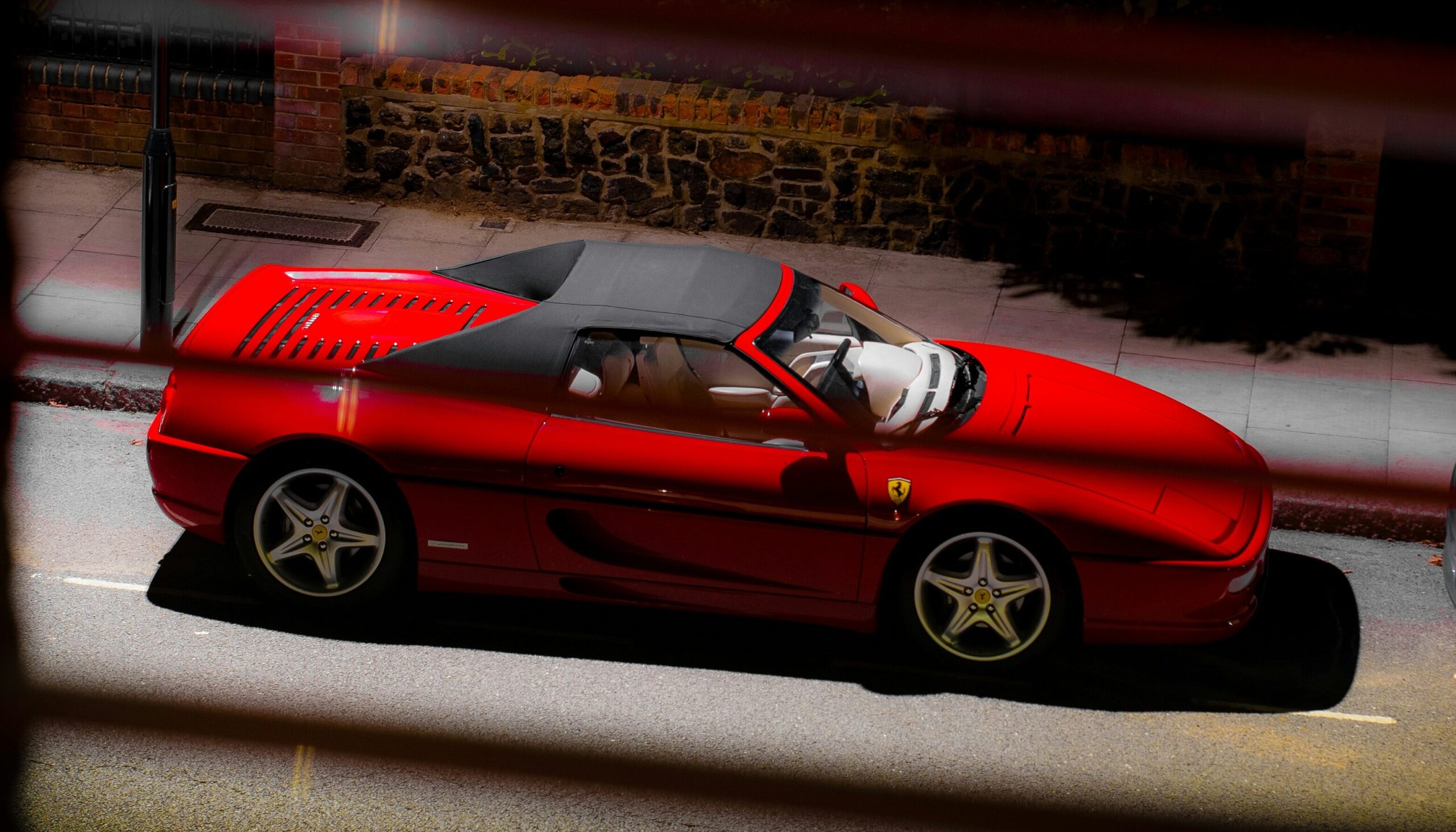
- Spider — Full convertible. Launched August 1995. 3,717 produced. Electrically folding soft roof sits almost flush with the rear deck. The most common body style after the Berlinetta; the one most people picture when they think of the F355.
Engine variants:
- Motronic 2.7 (1994–1995 model years) — Twin ECUs, twin air mass flow sensors, twin fuel pumps, twin lambda sensors. Widely regarded by F355 specialists as having a sharper throttle response. These are the earlier, pre-facelift cars.
- Motronic 5.2 (1996–1999 model years) — Single ECU introduced for the 1996 model year to meet US emissions requirements. Smoother delivery, more relaxed around town. The consensus among specialists is that these sacrifice a small amount of edge for a broader power band.
Transmission options:
- Six-speed manual — Open aluminium gate, rod-operated. Available for the full production run. Approximately 75% of all F355s produced have this transmission.
- F1 semi-automatic (1997–1999) — Single-clutch automated paddle-shift, introduced for the 1997 model year and derived from Ferrari’s Formula 1 programme. Around 25% of total production. Slower and jerkier than any modern dual-clutch system. Not the same thing as a true automatic — it is a manual with the clutch pedal removed and a computer making the clutch decisions.
Special and final editions:
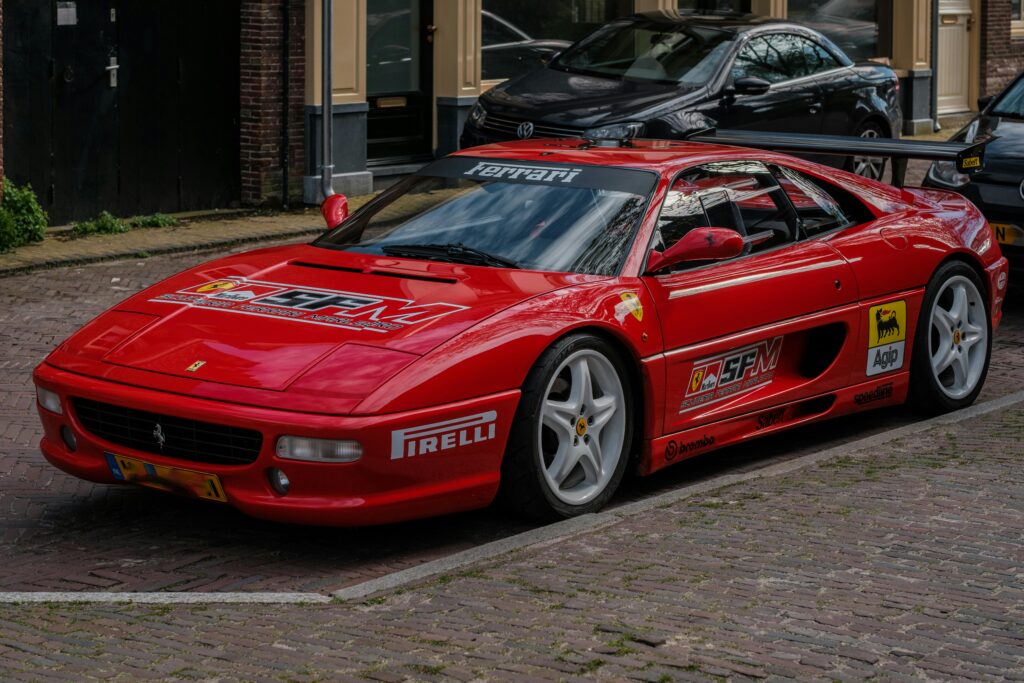
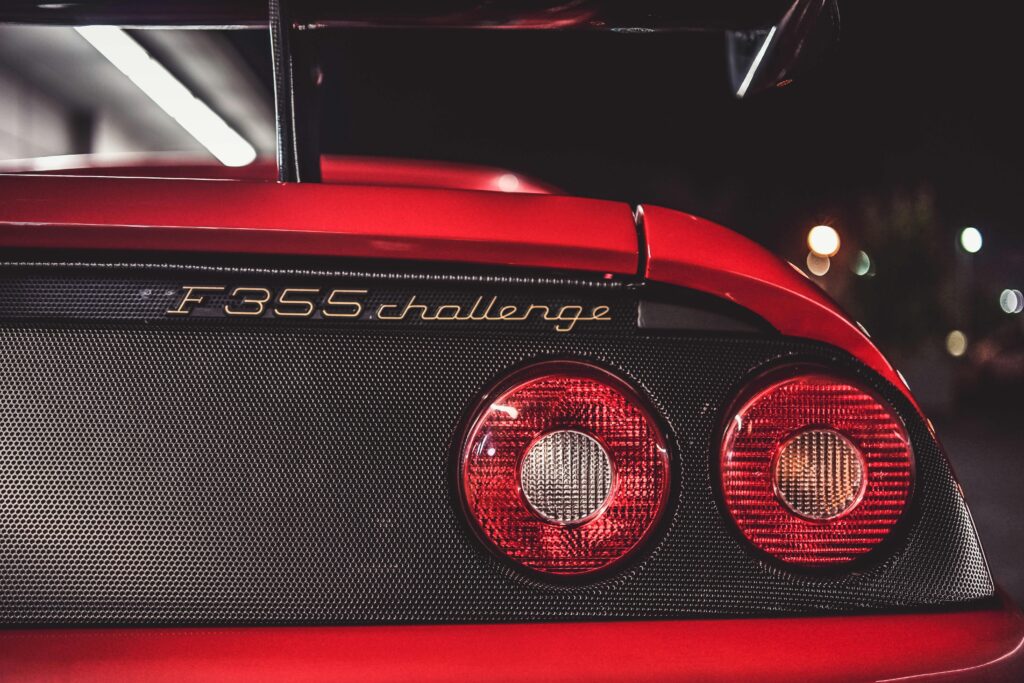
- F355 Challenge (from 1995) — Track-only race car built from the Berlinetta. Some subsequently converted to road-legal specification. Significantly lighter, with a faster steering rack and without the electronic dampers.
- Serie Fiorano (1999) — Final send-off edition. 104 produced. Upgraded with the quicker steering rack from the Challenge race car — one of only a small number of road cars to receive this setup. The most capable standard-specification F355 ever built.
The Ferrari F355 Investment Market
The F355 investment market is less stratified than the Porsche 996‘s but follows similar logic. Model hierarchy, transmission, body style, and condition drive value more aggressively than mileage alone. The spread between a tired F1 Spider and a low-mileage manual Berlinetta in a desirable color is enormous — and the distance between those two ends of the market is growing.
The F355 market is well-tracked on both sides of the Atlantic, and the numbers tell a consistent story. According to Classic.com US auction data, the average sale price of a Ferrari F355 investment car across all variants is $180,000 with the highest recorded sale reaching $588,000 for a 1999 F355 Spider Serie Fiorano on August 14, 2026.
The F1 Spider is the most accessible entry point in the US market. The average sale price of an F355 Spider with the F1 gearbox is $111,835 with the highest recorded sale at $182,980 for a 1999 example. In the UK, entry-level F1 Spider cars start from around £70,000.
Manual Ferrari F355s command premiums at every level on both markets. Manual GTS examples in the US have sold as high as $307,000, with recent listings running $190,000–$255,000 for good examples. The Classic.com average for a manual Berlinetta sits at $178,509.
Hagerty notes that prices have proved very stable, with a gentle rise year on year rather than the violent swings seen in other models. The strong dual demand — serious drivers wanting a usable Ferrari and collectors wanting a good example — has provided a floor that has held through multiple market cycles.
Ferrari F355 Investment Value Curve
Note: prices below reflect Classic.com US auction data at time of writing and will change over time.
| Variant | Entry | Average | High end |
|---|---|---|---|
| Berlinetta, F1 | ~$82,000 | ~$140,000 | $250,000+ |
| Berlinetta, manual | ~$116,000 | ~$180,000 | $350,000+ |
| Spider, F1 | ~$71,000 | ~$111,000 | $180,000+ |
| Spider, manual | ~$71,000 | ~$180,000 | $370,000+ |
| GTS, manual | ~$171,000 | ~$220,000 | $280,000+ |
| Serie Fiorano | ~$125,000 | ~$335,000 | $550,000+ |
Why It’s Going Up
Hagerty named the F355 its Gold Index Pick for 2025 and placed it on the 2025 Bull Market List. Numbers such as these show that the F355 is in a very good spot to continue its upward trajectory. Hagerty’s Collectability Algorithm places the F355 in the 83rd percentile — in the same range as the Subaru Impreza 22B, the Ferrari 365 GTB/4, and the Aston Martin DB5.
67% of Hagerty insurance quotes for the F355 worldwide come from people born after 1965. Gen X owners account for nearly 40% of quotes — well above the 31% average across all cars in the guide. This is not a model being held by an ageing group of original owners. The buyer base is younger than the car’s age would suggest. Picture this: Hagerty Price Guide Berlinetta ‘Excellent’ condition values have almost quadrupled since 2019, according to Price Guide Editor John Mayhead writing in Square Mile — outpacing both the 348 and the 360 over the same period.
A 1995 Spider sold for $240,800 in March 2025, and a 1997 example hammered at $337,750 at Broad Arrow Auctions in August 2025. The same cars traded at a median of $37,000 in 2013. However, in a years time, the record-breaking F355 sale came on August 14th 2026 when a Serie Fiorano Spider sold for a whooping $588,000.
Besides the numbers, there are a few things that also need to be taken into account. Yes, the F355 is expensive and difficult to maintain, and that is not a good look for a car seeking an investment position. On the bright side, this also means fewer and fewer good examples will remain, and that will make those specific examples more cherished. Many people draw a clear parallel between what the Porsche 930 did for Porsche and what the F355 is to Ferrari.
F355s with good maintenance history and a loving owner are the ones that will move the most. The math is simple — if maintenance issues, poor condition, and other similar problems are the reason the entire F355 market might not shoot up, then the cars that don’t have these issues are the ones that will go up. As Top Gear puts it: “The Ferrari F355 is not a modern supercar. There is no traction control, you can switch off the ABS,” and the F355 offers a driving experience that simply won’t ever be brought back.
The F355 is a looker, and that will keep it relevant forever, regardless of anything else. The F355 is never going to be forgotten or brushed aside the way the 348 already has been. As Doug DeMuro observed on the Spider: “this car is wonderful a joy to drive tremendously thrilling and gorgeous one of the most beautiful modern sports cars.” The fact that you can buy such a good-looking Ferrari with an amazing gated manual and a sonorous soundtrack is enough to push it up, especially since experiences like these are becoming increasingly hard to come by.
On the other hand, an F355 remains an expensive car to maintain properly, and deferred maintenance can erase years of appreciation quickly. Buyers treating the F355 as a passive investment rather than an actively managed collector car are likely to be disappointed. The honest version of the Ferrari F355 investment thesis is this: it requires buying the right car, maintaining it, and holding it through the period when its scarcity value fully catches up with its desirability. That is a ten-year thesis, not a two-year flip. The cars that will appreciate most dramatically are the ones that will be hardest to find in genuine, uncompromised, fully documented condition.
Common Ferrari F355 Problems
Every F355 problem is documented. All of them are addressable. The distinction between a good investment car and a money pit, in large part, comes down to whether they have been properly dealt with and whether you can prove it.
- Cam belts. The defining maintenance event of F355 ownership. Ferrari’s own service interval was every three years. The engine likely must be removed to replace them — any specialist attempting the job through the fuel tank hole is taking a shortcut that most experts do not endorse. Cost: $10,000–$16,000 with engine out, addressing all associated items (tensioners, water pump, belts). On a car that has been in storage, even recently replaced belts should be inspected: tensioners can release oil and allow belts to slacken during prolonged standing.
- Exhaust manifolds. A known failure point. Hairline cracks in the manifolds cause a cold tick at startup that goes away once the engine is warm. If left unaddressed, cracked manifolds can overheat exhaust valves and cause serious engine damage. Manifolds run $4,000–$6,000 a side new, plus labour. Listen for any ticking on startup that disappears once warm — this is the signature symptom.
- Valve guides (early cars). Early F355s used bronze valve guides that wore over time, causing oil consumption and smoke on the overrun. Most properly maintained early cars have had this addressed by now. If purchasing an early Motronic 2.7 car, specifically ask when the valve guides were last inspected and whether any replacement work was done.
- Fuel system and fire risk. Ferrari issued a recall on the F355 for fuel pipes, but that recall was performed over ten years ago on cars that are now approaching 30 years old. Rubber fuel lines — including the braided lines where internal rubber deterioration is invisible from outside — will have continued to degrade. A fire risk on a car this age is not hypothetical. Know when the fuel lines were last replaced and replace them proactively if the date is unknown or distant.
- Exhaust bypass valve. The F355 has an active exhaust valve that opens at higher revs to bypass part of the system and produce the characteristic bark. The valve pivots on small brass bushings that wear over time and cause a rattle. Some owners wire the valve permanently open — not ideal, as this defeats the emissions system and causes other issues. Listen for any exhaust rattle and check whether the valve has been tampered with.
- Brake fluid crystallisation. A specific problem flagged by specialists: brake fluid in F355s stored for extended periods can crystallise and block caliper passages, leading to uneven brake pressure, squealing, and ultimately caliper failure. The ABS components are now more difficult to come by. Annual brake fluid changes are not optional maintenance on a car of this age — they are essential prevention.
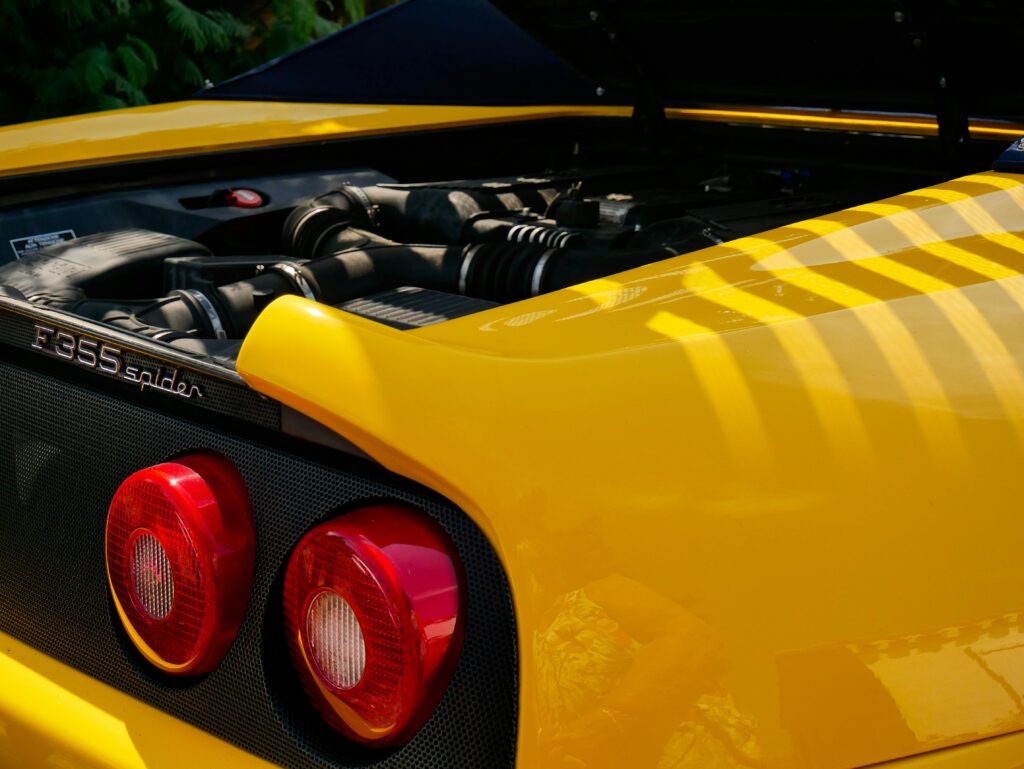
- Rear buttresses. The flying buttresses on the rear quarters of the Berlinetta and GTS are the car’s most famous styling feature and also its most famous rust trap. Water collects at the junction between the buttress and the body, and virtually every F355 that has seen regular use will have had a repair and respray here. The quality of the repair work affects value significantly. Look carefully at the paint condition in this area and ask for receipts.
- Wheel bolt inserts. The alloy wheels have inserts where the wheel bolts pass through. These crack over time, particularly if wheel bolts have been overtightened. Replacement inserts are now available from aftermarket suppliers and can be pressed in, but look for evidence this has been done — and check each wheel bolt area carefully during any inspection.
- Radiators. The front-facing radiator apertures scoop air through large intakes. They also scoop leaves, mud, and debris that collect at the bottom of the radiator and rot it from the inside. Shine a torch into the radiator intakes on any prospective purchase. A blocked, corroding radiator on a car this age is a significant repair.
- Sticky switches. The interior switchgear uses a rubberised coating that degrades with age, becoming sticky and unpleasant to touch. Affected cars feel neglected even if mechanically sound. Re-covering all affected switches is possible but expensive. Factor it into any purchase negotiation.
- Spider roof mechanism. The Spider’s electrically folding roof operates through a combination of hydraulics and electrics, and the seats must move forward on a specific pattern to clear the folding mechanism. Potentiometers in the seat tracking system tell the roof computer where the seats are — when these fail, the entire sequence can malfunction. Specialist repair, not inexpensive.
- F1 gearbox. The single-clutch automated transmission requires a specific driving technique and can consume a clutch rapidly if used heavily in urban conditions. It is less smooth and less capable than any modern dual-clutch system. A poorly maintained or abuse-history F1 car can arrive with a clutch near the end of its life. Test the gearbox carefully in traffic and at low speeds.
What to Look for in a Good F355 Investment Car
Although it is never easy to know what the market will do next, there are some indications that certain factors are going to put the Ferrari F355 investment in a more favorable position.
Service History
On the F355, service history is not a nice-to-have. It is the document that tells you whether you are buying a safe, maintained car or a collection of deferred problems in a beautiful wrapper. Specifically: cam belt change date, manifold inspection history, fuel line replacement date, valve guide status on early cars. Any gap in the record should be treated as a red flag. No record at all should end the conversation.
Cam Belt Status
Ask the specific question. When was the last belt change? By whom? With the engine out or via the shortcut method? A documented belt service from a recognised Ferrari specialist, with the engine properly removed, transforms the risk profile of the car. If it is overdue or unknown, factor in the full cost — $10,000–$16,000 — as a non-negotiable immediate expense and negotiate accordingly.
Transmission
Buy the six-speed manual. This is not an aesthetic preference — it is an investment decision. Manual F355s trade at a premium in every configuration and the gap is widening. Around 75% of all F355s have the manual, but in the current market, manual examples sell faster and for more money than F1 cars in equivalent condition. If you are buying for driving pleasure and investment value simultaneously, the manual is the only answer.
Body Style
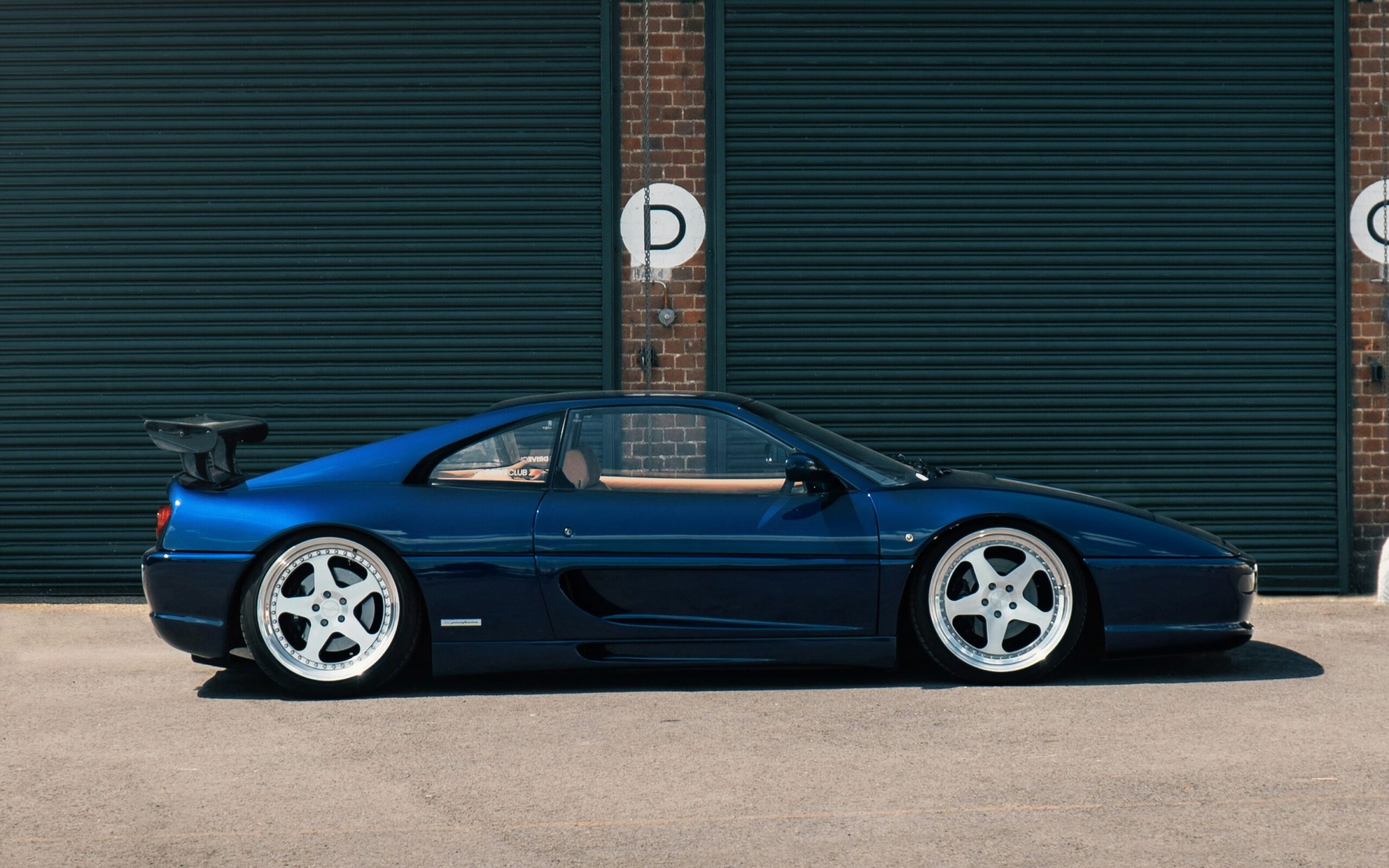
The Berlinetta is the purist choice and the one with the clearest investment thesis: lowest entry price in some configurations, most desirable to the largest pool of future buyers, and the body style that most people picture when they think F355. The GTS is the rarest and commands the highest prices for exceptional examples — but its rarity also makes it harder to find in genuinely good condition. The Spider is the most accessible but carries the roof mechanism risk.
Color
Color matters on the F355. Rosso Corsa (red) over Crema or tan leather is the definitive specification — Doug DeMuro, reviewing a red-over-tan example, described it as “perfect colors” for exactly the reason the market agrees with him. Yellow and black are the other strong investment colors. Standard silver and dark blue — the largest share of what is available on the market — are the least interesting from a value perspective. Rare paint-to-sample colors occupy a specialist market.
Condition Integrity
On a car of this age and price, originality and overall integrity of the car as an object matters as much as mechanical condition. Original glass with matching factory etch marks. Original toolkit in the leather briefcase (they go missing and sell separately for significant money). Original books, keys, spare wheel or can of mousse. The factory satin black finish on the inside of the bonnet — if it is gloss, the bonnet has been refinished and the car has had front-end accident damage. These details separate a ten-out-of-ten car from everything else, and the market prices them accordingly.
Pre-Purchase Inspection
Have any prospective F355 purchase inspected by a specialist who works on these cars regularly before committing. A proper PPI on an F355 should include: borescope inspection of the engine bay, compression test, detailed inspection of the fuel lines, cam belt status verification, exhaust manifold inspection, brake fluid assessment, full electrical check, and a thorough examination of the rear buttress area and underside for corrosion. This is not a car you buy on photographs and a description.
Best Ferrari F355 Investment Tiers
Tier 1
Serie Fiorano: the definitive F355
104 Serie Fiorano cars were built as the final send-off for the F355 in 1999. Each one came with the quicker steering rack from the F355 Challenge race car — making it the most resolved driving experience available in any road-specification F355. Production numbers so small they barely register against the 11,522 total. These are already being treated as the top tier of the F355 market and prices reflect it. The window on a bargain here closed years ago, but as a hold, these are as close to unconditional as the F355 market gets.
Tier 2
Manual Berlinetta, early Motronic 2.7, exceptional condition
The manual Berlinetta in the earliest specification — pre-1996, Motronic 2.7, three-spoke non-airbag steering wheel — is the car that the most serious F355 collectors want. The sharper throttle response of the twin ECU system and the unencumbered steering wheel design represent the purest expression of what the F355 was at launch. In genuinely exceptional condition with a full documented history and desirable colour, these cars are approaching big money.
Tier 3
Manual GTS in exceptional condition
The GTS is the rarest body style at 2,577 units and carries a glass rear window that the Spider does not. In a strong manual specification with documented history, GTS values reach $280,000 for the best examples. The challenge with the GTS is finding one — because they are rare, genuinely excellent examples appear infrequently. When they do, they move quickly. The investment case is strong, but patience is required.
Tier 4
Manual Berlinetta or Spider, Motronic 5.2, good documented condition
A well-maintained manual F355 Berlinetta or Spider from the later production run, in good condition with a verifiable history, is the strongest accessible entry point into the Ferrari F355 investment market. These represent the broadest pool of buyers on the way out — anyone who wants a manual F355 will consider one. Buy the best-conditioned example you can find, verify the cam belt and fuel lines, and hold.
Avoid
F1-gearbox cars in any configuration without an exceptional provenance argument, cars with unknown maintenance history regardless of mileage and appearance, heavily modified examples with aftermarket exhausts and non-original interior work, any car where the rear buttress work is poorly executed or unrecorded, and any Spider where the roof mechanism has not been recently serviced. The market for these has already separated them clearly from investment-grade examples.
The Ferrari F355 Investment Verdict
The Ferrari F355 investment case rests on a simple observation: this is one of the most beautiful regular-production Ferraris ever made, it is the last of a specific and irreplaceable driving experience, and it is still available for less money than many of the cars it will eventually be compared with.
The arguments against it are real — maintenance costs, parts availability, production numbers — but they are the same arguments that suppressed the 996 for twenty years and have now been proven wrong by the market. The F355’s fear premium is its cam belt service. That is a $15,000 job, not a $65,000 engine replacement. The buyers who treat it as the latter have kept prices accessible for the buyers who understand the former.
The Serie Fiorano and the finest manual Berlinettas are already out of reach for anyone looking for a bargain. The mid-tier manual market — good condition, documented history, correct specification — still offers genuine value. The window on that value is measured in years, not decades. Buy the manual. Buy the Berlinetta. Verify the cam belt. Replace the fuel lines. Keep it original. Find the service history.
Classic Car Gang covers the modern classics market with no editorial filters. If you found this useful, check out our other articles.
Get notified when we publish new articles. No spam.

Marko Mikulic is a classic and modern classic car writer with over a decade of hands-on enthusiasm. He has published more than 10,000 automotive articles with bylines at Jalopnik, SlashGear, The Driver Advisor, and CarArac. He owns a Mercedes R129 SL — having previously owned an R107 and a BMW E30 M3. He founded Classic Car Gang to cover the cars worth buying, owning, and investing in, without editorial filters.