


The Ferrari F355 vs Porsche 996 Turbo is one of the defining choices in the modern performance classic car market — two cars built at the same moment in history, costing roughly the same money today, attracting roughly the same type of buyer.
One is a naturally aspirated mid-engine sculpture that demands full commitment and rewards it with a sound and feel that very few cars in history have matched. The other is a rear-engined twin-turbocharged weapon that will embarrass nearly anything on the road, start every morning, and still be running flawlessly at 80,000 miles.
Choosing between them is not a question of which car is better. It is a question of what kind of owner you are — and being honest about that before you spend the money. Here is our full Ferrari F355 vs Porsche 996 Turbo breakdown.

Table of Contents
Ferrari F355 vs Porsche 996 Turbo: Quick Specs Comparison
Here is a quick look at all of the basics. For this comparison, we are using the F355 Berlinetta — the body style most commonly compared to the 996 Turbo and the most relevant choice for the majority of buyers.
| Ferrari F355 Berlinetta | Porsche 996 Turbo | |
|---|---|---|
| Years | 1994–1999 | 2001–2005 |
| Engine | 3.5L flat-plane V8, 5 valves/cyl | 3.6L twin-turbo flat-six |
| Power | 375 bhp @ 8,250 rpm | 415–420 bhp |
| Torque | 268 lb-ft @ 6,000 rpm | 413–415 lb-ft @ 2,700–4,600 rpm |
| 0–60 mph | ~4.5 sec (manual) | ~3.9 sec (manual) |
| Top Speed | 183 mph | 189 mph |
| Weight (kerb) | ~3,300 lb | ~3,395 lb |
| Drive | RWD, mid-engine | AWD, rear-engine |
| Transmission | 6-speed manual / F1 paddle | 6-speed manual / 5-speed Tiptronic |
| Production | ~11,000 total | ~22,000 total |
| US Price (new) | ~$130,000–$150,000 | ~$116,000–$130,000 |
The Cars: What You’re Actually Buying
Here is a quick overview of what each car is and where it comes from before we get into how they compare.
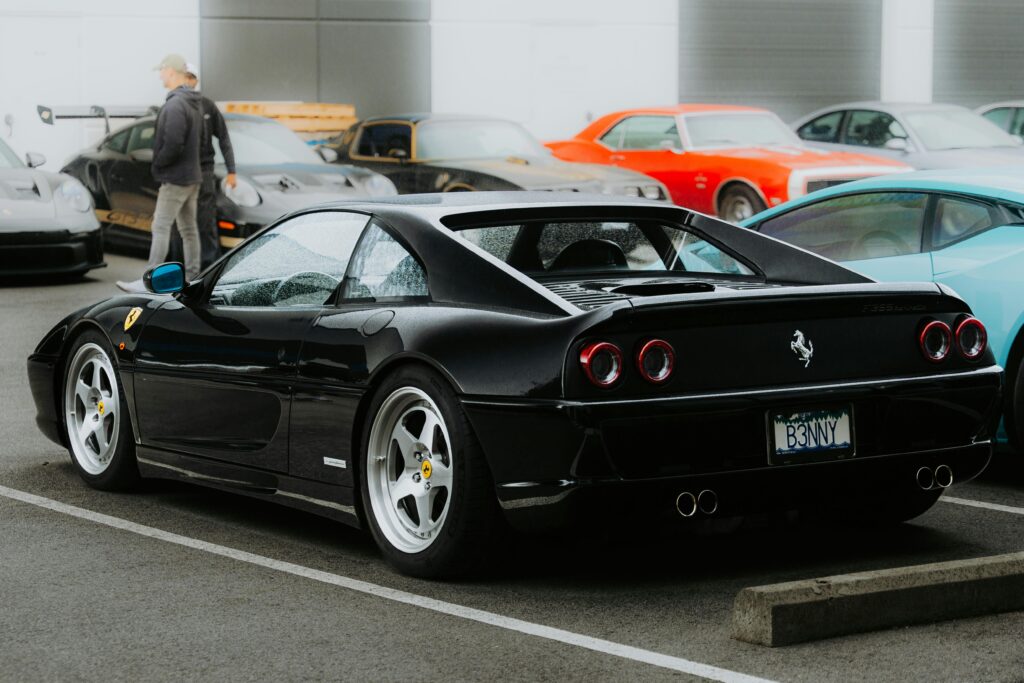
Ferrari F355
The Ferrari F355 arrived at Geneva in March 1994 as Ferrari’s answer to a problem the 348 had created: the Honda NSX had made the mid-engine Italian supercar look lazy and badly finished. Ferrari’s response was comprehensive.
A new 3.5-litre flat-plane V8 with five valves per cylinder — the name means 3.5 litres, five valves — producing 375 bhp and capable of 8,500 rpm. A redesigned chassis with double wishbone suspension, electronic dampers, and a flat aerodynamic undertray. A gear linkage changed from cables to rods. The result was a car that completely transformed Ferrari’s reputation for the mid-engined V8 class.
The body was designed by Pininfarina and remains one of the most admired production car designs of the 1990s. Around 11,000 F355s were built across three body styles — Berlinetta, GTS targa, and Spider — before production ended in 1999 to make way for the 360 Modena.

Porsche 996 Turbo
The Porsche 996 Turbo arrived for the 2001 model year as the non-GT performance flagship of Porsche’s controversial water-cooled 911 generation. Where the base 996 Carrera used the M96 engine that earned a reputation for IMS bearing failures, the Turbo used the Mezger engine.
This engine was derived directly from the GT1 Le Mans race car, with a dry-sump lubrication system and twin turbochargers producing 415 bhp in standard form and 450 bhp in the X50 power kit specification. The Mezger is, by wide consensus among Porsche specialists, one of the most robust engines ever fitted to a road car.
The 996 Turbo also came standard with Porsche’s all-wheel drive system, larger Turbo-look bodywork with wider rear quarters, and a suspension setup derived from the GT3. In standard form it reached 60 mph in 3.9 seconds. With the X50 package — it was one of the fastest production cars money could buy in 2001.
Ferrari F355 vs Porsche 996 Turbo: The Driving Experience
These two cars represent genuinely different philosophies of what a performance car should do, and the driving experience reflects that completely.
Engine, Performance, and Speed
Below 5,500 rpm, the Ferrari’s engine is relatively unremarkable. Above that point, and particularly as it approaches its 8,500 rpm limit, it becomes something else entirely. The F355’s 3.5-litre flat-plane V8 with five valves per cylinder produces 375 bhp at 8,250 rpm and 107 hp per litre, making it one of the highest-revving naturally aspirated road car engines of its era.
The F355 is also pushing “only” 268 lb-ft at 6,000 rpm, meaning it never feels intimidating — it rewards commitment rather than demanding caution. With 375 horsepower, it is the underdog in this comparison, but the F355 makes up for it with how it delivers that power.
Compared to the 996 Turbo, the F355’s engine is a lot more visceral, more raw, and in simple terms — more exciting when on the limit. On the other hand, at 2,700 rpm, the Porsche’s 3.6-litre twin-turbocharged flat-six delivers 413 lb-ft of torque — over 50% more twist than the F355 produces at peak — with 415 bhp in standard form and 450 bhp in X50 specification.
On raw performance, the 996 Turbo wins without argument. It is faster 0-60 mph, it has the higher top speed, more power, more torque, and is likely to outrun the F355 on most roads. It gives you the classic “Turbo” driving experience. The F355 wins on the terms of the sensory performance experience. It’s more of a supercar, even though it may not be going as fast.

Handling, Driving Feel, and Character
The mid-engine layout gives the F355 a balance you’d come to expect from a Ferrari. Adam Saruwatari of Adam Saruwatari Xtreme (who owns both cars btw) was direct about the chassis after driving both back to back: “There’s no question the 355 handles better. The car is much more balanced — the 355 just kind of seems to have the right amount of power for how much the chassis can hold.”
The manual gearbox, through the open aluminium gate, forces deliberate, precise shifts — the kind of mechanical “click-clack” that defined the gated manual. The flat-plane crank V8 produces a note many regard as one of Ferrari’s greatest hits. With an F1 gearbox, the F355 is fast, but as involvement and driving feel goes, the manual is king.
The 996 Turbo communicates plenty through its steering and chassis. It is far from being numb — but it does so with a composure that makes it accessible rather than demanding. However, the sound and feel behind the wheel are far from the F355. The Turbo also relies on AWD, and if you want that rear-end fighting for traction feeling, the F355 is the clear pick.
Car and Driver tested the 996 Turbo when it came out, and they said that it ” doesn’t sound like a Porsche” because of how muted it is. This is the complete opposite of the F355. Yet, with a classic 911 rear-mounted engine architecture, the 996 Turbo drives drama-free. It does what you tell it to do, and it does it wonderfully.
Daily Driving, Comfort, and Features
Granted, hardly anyone is going to cross-shop the F355 and the 996 Turbo for grocery shopping, but it’s still very important you can use these. Given that many owners of these cars use them for rallies, cross-country drives, and even city driving, it is important that they fit the bill. With that in mind, the F355 is not a daily car.
The engine needs to be worked to come alive, the steering is weighty, and both the manual and the F1 are not as sophisticated as Porsche’s Tiptronic or manual. The F355 asks something of you every time you drive it — and if you are not in the right frame of mind, that can feel like a burden rather than a reward.
Multiple F355 owners across put a 3,000–5,000 mile annual ceiling on sensible F355 use. As one PistonHeads regular summarised it plainly: “Daily smoker = 996 Turbo. Weekend toy = F355.” The 996 Turbo starts reliably in all weather, delivers its pace without drama, and covers ground at a pace that embarrasses cars costing far more.
On interior and ergonomics, the Ferrari F355 vs Porsche 996 Turbo comparison is remarkably one-sided. The Porsche feels higher-end, it is better equipped, its AWD system makes sense in colder climates, and it does not look as dated as the F355.

Ferrari F355 vs Porsche 996 Turbo: Design Language
As they say: “beauty is in the eye of the beholder,” but most beholders that are also car enthusiasts are going to pick the F355 over the 996. The F355 was designed by Pininfarina at a moment when visual drama was the primary objective — before aerodynamic efficiency and coefficient of drag calculations began dictating form.
The result is a car that has not aged in the way that most 1990s performance cars have. Many deem the F355 as one of the best-looking Ferrari’s from its era. The 996 Turbo’s design is more functional and more controversial. Porsche being Porsche, actually dedicated a big part of the 996 Turbo launch to the fact that it “produced a lift coefficient of minus 0.01 at the rear.”
Additionally, the “fried egg” headlights of the pre-facelift 996 remain the most debated styling choice in modern Porsche history. The 2002 facelift addressed this with cleaner headlamp units, and the Turbo’s wider bodywork with its flared rear quarters gives it a more aggressive stance than the base Carrera. It is a good-looking car, but it is not the Ferrari F355.

Ferrari F355 vs Porsche 996 Turbo: Reliability and Maintenance
With the Ferrari F355, the defining cost is the cam belt service — an engine-out job that runs $5,000–$12,000 at a reputable specialist. The 996 Turbo uses a timing chain and has no equivalent cost. Exhaust manifolds are the other serious item: the flanges crack due to extreme heat cycling, with replacement running $4,000–$6,000 per side.
Early cars — particularly 1995 models — also had bronze valve guides that wore prematurely, with bad batches finding their way into later years including 1998. On top of the known mechanical issues, parts availability is an ongoing problem. As one long-term F355 owner put it on Rennlist: “Ferrari does an absolutely abysmal job of making spare parts for their older cars available, and often it’s up to your mechanic to scrounge all his known sources to find the needed part.”
The 996 Turbo’s Mezger engine does not share the base 996 Carrera’s IMS bearing vulnerability — it was derived from GT1 Le Mans race car hardware and built to a categorically different standard. Multiple long-term owners report running their 996 Turbos past 60,000 and 70,000 miles without significant mechanical issues, figures that would be considered extraordinary on a well-used F355. The timing chain eliminates the F355’s biggest scheduled cost entirely, and parts remain widely available.
Still, the 996 Turbo is not without its own costs — clutch replacement and coilover service both require attention over time — but the ownership experience is a different proposition entirely. One PistonHeads member who previously owned both Porsches and an F355 Spider described: “The 355 is just fantastic, a real keeper — but if I were you I would go for the turbo with a good warranty.”
In routine years, the two cars cost surprisingly similar amounts to maintain — expect $3,000–$5,000 annually for either car driven sensibly, covering oil changes, tires, brakes, and minor items. Averaged across a typical ownership period, the F355 costs meaningfully more to run — not because it breaks more often, but because its scheduled maintenance is in a different price bracket entirely.

Ferrari F355 vs Porsche 996 Turbo: Investment Value
According to Classic.com US auction data, the average sale price across all F355 variants is $148,904. The manual Berlinetta averages $151,485. The F1 Spider — the most accessible entry point — averages $97,416.
The trajectory is clearly upward. A 1995 Spider sold for $240,800 in March 2025, and a 1997 example hammered at $337,750 at Broad Arrow Auctions in August 2025. The same cars traded at a median of $37,000 in 2013. Hagerty named the F355 its Gold Index Pick for 2025 and placed it on the Bull Market List, with its Collectability Algorithm placing it in the 83rd percentile. According to Square Mile, 18% of F355 owners are under 40 — higher than the Porsche 911 993, the Ferrari Testarossa, the 360, and nearly three times more than for the 550 Maranello.
The investment case has one clear condition: it depends entirely on buying the right car. A well-documented, properly maintained manual F355 Berlinetta or GTS in a desirable colour is an appreciating asset. A deferred-maintenance example with unknown cam belt history is a liability, regardless of what it sells for.
According to Classic.com data, the average sale price of a 996.2 Turbo is $68,729, with the highest recorded sale reaching $180,000 + for a rare special example. Standard manual 996 Turbos in good condition trade in the $60,000–$90,000 range currently, with X50 cars commanding premiums.
The 996 Turbo’s investment story is different from the F355’s. Its value proposition is reliability and usability at a fraction of the F355’s price — and its ceiling is lower. The 996 Turbo is unlikely to reproduce the F355’s appreciation trajectory because it lacks the emotional and aesthetic narrative that drives collector demand at the top of the market.
The Mezger engine gives it a legitimate mechanical story, and the X50 cars have a strong following, but the 996 Turbo will always sit below the F355 in collector hierarchy.
For buyers whose primary goal is enjoyment rather than appreciation, the 996 Turbo offers significantly better value per pound of performance. For buyers whose primary goal is long-term value appreciation, the F355 — bought correctly — has the stronger case.
Either way, if you want more insight into the F355 or the 996 as standalone investments, be sure to check out our full Ferrari F355 Investment Guide and Porsche 996 Investment Guide.

Ferrari F355 vs Porsche 996 Turbo: Which One Should You Buy?
Not everyone wants the same things in life. Some will see the Ferrari’s rawness as its soul — others will see it as its demise. Some will appreciate the 996 Turbo’s Tiptronic as a capable daily driver, while Porsche purists will always reach for the manual.
Here are a few factors to keep in mind to help you make the right choice.
Buy the Ferrari F355 if:
- The driving experience — the sound, the gate, the communication — is the primary reason you are buying a car at this level
- You have a separate daily driver and the F355 will see 2,000–5,000 miles per year maximum
- You can budget more for yearly maintenance and running costs
- You are buying for long-term appreciation and understand that buying the right car — manual, documented history, correct specification — is non-negotiable
- You want the car in your garage that you still walk out to look at two years later
Buy the Porsche 996 Turbo if:
- You want to drive the car regularly, including as a semi-regular daily car, without worrying about every mile
- You want supercar performance — sub-4-second 0–60, real-world usability in all weather conditions
- Your budget for maintenance is fixed and not willing to accommodate surprises
- You prioritise the ownership experience over the emotional statement
- You want the car that will still be running flawlessly at huge miles

Ferrari F355 vs Porsche 996 Turbo: The Verdict
The 996 Turbo is the better car by almost every rational measure. It is faster, more reliable, cheaper to maintain, more usable, and will embarrass far more expensive machinery without drama or incident. If you are asking which car makes more practical sense at this price point, the answer is the Porsche — and it is not close.
However, the F355 is the more significant car. It represents something the 996 Turbo does not and cannot: a specific, irreplaceable driving experience built around a naturally aspirated engine revving to 8,500 rpm, an open-gated manual gearbox, and a Pininfarina-designed body that many believe is top-level Ferrari. These things are gone from new car production. The F355 is one of the last places you can find them together in a single package.
The people who own both tend to arrive at a consistent and surprising conclusion. Adam Saruwatari, who owns a modified 996 Turbo alongside his F355 and gave the Porsche the practical nod across most categories, was asked the defining question: if he went back and could only choose one car to buy first, which would it be? “The answer is simple for me — I’d still get the 355 first, because there’s just something about Ferraris, and those of you that own them, have owned them, and drive them know what I’m talking about.”
That is the most honest summary of this comparison available. The 996 Turbo is the better car. The F355 is the one people want more.
Classic Car Gang covers the modern classics market with no editorial filters. If you found this useful, check out our other articles.
Get notified when we publish new articles. No spam.

Marko Mikulic is a classic and modern classic car writer with over a decade of hands-on enthusiasm. He has published more than 10,000 automotive articles with bylines at Jalopnik, SlashGear, The Driver Advisor, and CarArac. He owns a Mercedes R129 SL — having previously owned an R107 and a BMW E30 M3. He founded Classic Car Gang to cover the cars worth buying, owning, and investing in, without editorial filters.